Table of Contents
ToggleDark countertops have evolved from a risky design choice to one of the most versatile and timeless options in modern kitchens. Whether you’re drawn to sleek black granite, warm soapstone, or rich engineered stone, dark countertops create instant visual impact and anchor your entire kitchen design. They hide stains and scratches better than lighter surfaces, demand less maintenance than you’d think, and pair beautifully with virtually any cabinet color, from bold whites and warm woods to cool grays and deep charcoals. If you’re considering a kitchen refresh or renovation, understanding how to select and style dark countertop kitchen ideas will help you make a choice that looks sophisticated for years to come.
Key Takeaways
- Dark countertop kitchen ideas offer practical advantages: they hide stains and scratches better than light surfaces, reduce maintenance time, and provide visual anchoring that creates kitchen cohesion.
- Black granite and engineered quartz are the most durable dark countertop options, with quartz requiring no sealing and ranging from $50–$120 per square foot installed.
- Warm dark countertops like soapstone and black marble add character and sophistication, though they require more careful maintenance than granite and pair beautifully with lighter cabinet colors.
- Successful dark countertop kitchens balance visual weight with adequate lighting—combine recessed ceiling lights with under-cabinet LED strips to prevent the space from feeling cave-like.
- Cabinet pairings make or break the design: light cabinets create modern contrast, warm wood tones suit farmhouse styles, and gray cabinetry requires careful tone matching to avoid a flat appearance.
- Dark countertop maintenance varies by material—quartz needs only daily wiping, while granite requires sealing every 1–3 years, and wood demands annual oiling and cutting board use to prevent damage.
Why Dark Countertops Are a Smart Kitchen Choice
Dark countertops offer practical and aesthetic advantages that make them worth serious consideration. First, they’re forgiving: daily crumbs, water spots, and minor scratches disappear on a dark surface in ways they don’t on white or cream countertops. This means you spend less time cleaning and more time actually using your kitchen.
Second, dark surfaces make kitchens feel grounded and intentional. A dark countertop becomes the visual anchor that everything else organizes around, your cabinetry, backsplash, and lighting all become supporting players rather than competing elements. This creates cohesion even in open-concept homes where visual chaos can be a real problem.
Third, dark countertops pair flexibly with kitchen cabinet colors with black countertops ranging from traditional wood tones to contemporary whites. You’re not locked into one aesthetic direction. A homeowner with black quartz counters can choose warm oak cabinets for farmhouse style or crisp white ones for modern minimalism. The dark base gives you permission to experiment above it.
Finally, dark materials hold their value. Unlike trendy pastels or novelty finishes, black and charcoal countertops have remained consistently popular for over a decade. From a resale perspective, they’re a safer bet than choices that might feel dated in five years.
Sleek Black Granite and Quartz Countertops
Black granite is the heavyweight champion of dark countertop materials, durable, heat-resistant, and naturally occurring. Absolute Black granite is the most sought-after variety: it’s nearly uniform in color with minimal veining, creating a seamless, modern look. Real granite runs $40–$100 per square foot installed, depending on thickness (typically 1.25″ nominal) and your region.
Quartz offers a manufactured alternative that’s actually harder and less porous than granite. With quartz, you get consistent color, zero sealing requirements, and engineered stain resistance. Engineered black quartz (brands like Silestone, Cambria, or LG Viastone) costs $50–$120 per square foot installed and comes in finishes ranging from high-gloss to matte or textured.
When installing either material, ensure your cabinetry is properly leveled and shims are set correctly. Granite and quartz are heavy, roughly 20 pounds per square foot, and they need solid support. If you’re replacing existing counters, the removal process may reveal soft spots in the substrate that need reinforcing before the new surface goes down.
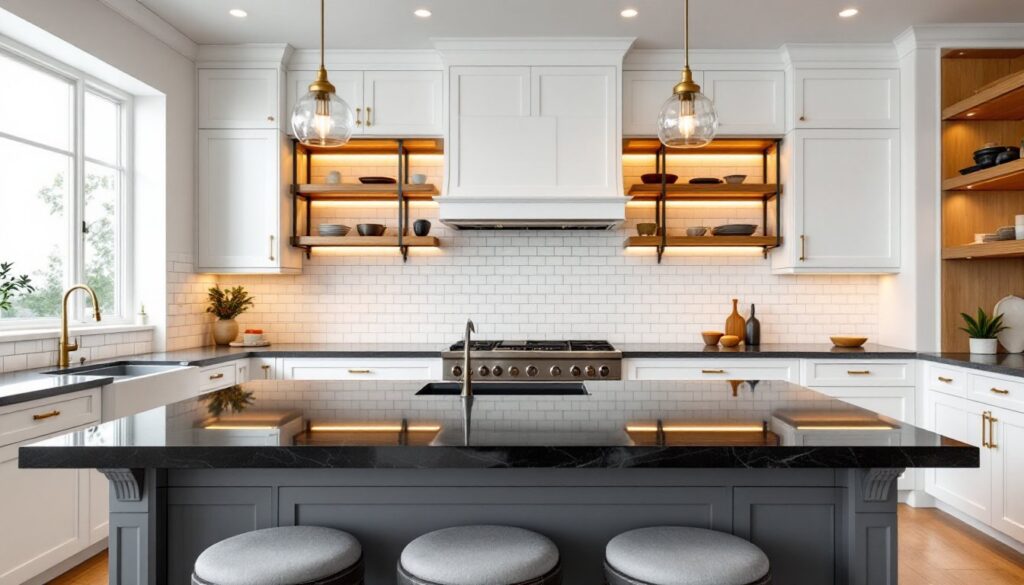
For kitchen cabinets with black countertops, consider your cabinet finish carefully. Soft white or cream cabinets create classic contrast: warm honey-toned wood grounds the dark base and adds warmth: or go bold with dark gray or charcoal cabinetry for a cohesive, moody aesthetic. The key is ensuring adequate lighting, under-cabinet LED strips and proper overhead fixtures prevent the space from feeling cave-like.
Warm Dark Marble and Soapstone Options
If you want character and movement in your dark countertop, black marble delivers with dramatic white or gray veining that catches the eye. Nero Marquina and Black Portoro marble are popular Italian options featuring bold, sculptural patterns. These stones feel luxurious and add visual interest that solid black materials can’t match, though they’re softer than granite and require regular sealing (every 6–12 months) and careful use around acidic liquids like vinegar and lemon juice.
Soapstone is an underrated choice that brings warmth dark granite lacks. It’s a natural metamorphic rock with a matte, almost silky appearance and ranges from charcoal to near-black with subtle natural variation. Soapstone is naturally non-porous, so it doesn’t need sealing, and it’s heat-resistant (you can set a hot pan straight on it without damage). The downside: it’s softer than granite and can scratch, though many homeowners embrace this patina as part of its charm. At $70–$120 per square foot installed, it costs similarly to quartz.
Both marble and soapstone pair beautifully with warmer cabinet colors, think light gray, soft white, or natural wood tones. The movement in the stone bridges the gap between cool and warm, making the whole kitchen feel sophisticated rather than stark. If you go this route, use cutting boards religiously and wipe spills immediately: both materials are more sensitive to acids and oils than granite or quartz.
Modern Dark Butcher Block and Wood Countertops
Wood countertops bring warmth that stone can’t, and when finished dark, they deliver unexpected drama. Dark walnut and wenge are hardwoods that age beautifully, developing a patina over years of use. Oiled finishes show natural wood character: polyurethane seals provide more protection but can feel plastic-like and require professional recoating every few years.
Butcher block, typically made from edge-grain or end-grain hardwood strips glued together, can be stained dark for a contemporary look that feels organic rather than cold. Food-safe mineral oil or specialized wood conditioner maintains the finish and prevents drying and cracking. Unlike stone, you’ll need to refresh the finish annually or every other year, and you must use cutting boards and avoid prolonged water exposure.
Wood countertops cost $30–$100 per square foot installed and suit farmhouse, rustic, or transitional styles beautifully. They pair naturally with light or medium cabinets, the contrast prevents the dark countertop from overwhelming the space. Avoid pairing dark wood counters with very dark cabinets unless you’re going full moody-luxe: the effect can feel heavy.
One practical note: wood isn’t ideal around the sink unless you install a dedicated stainless-steel insert and are meticulous about moisture management. Most experienced DIYers reserve dark wood for island or prep-area countertops where water exposure is minimal. If you want the warmth of wood in a high-moisture zone, consider a hybrid approach: stone around the sink and wood elsewhere.
Dark Concrete and Engineered Stone Solutions
Concrete countertops have moved beyond industrial-warehouse aesthetic into sophisticated home kitchens. Polished concrete stained dark gray or charcoal offers customization, you can embed decorative elements, create beveled edges, or pour it to fit unusual layouts. DIY concrete countertop kits exist, but poured-in-place installations are best handled by experienced professionals: the curing process, aggregate sealing, and achieving a smooth, level surface demand precision.
Polished concrete shows fingerprints and requires consistent sealing (annually or biennially) to resist stains and water damage. It’s warm to the touch and develops character over time, the opposite of sterile. At $65–$150 per square foot installed, it costs more than you might expect, but the customization potential justifies the investment if you want something truly unique.
Engineered stone (also called quartz composite) offers darker color options with more pattern variation than solid quartz, think a base that’s nearly black with flecks of mirror, sparkle, or subtle veining. Silestone’s Eternal Noir or Cambria’s Brittanica Noir are examples. These materials solve the durability equation (non-porous, heat-resistant, no sealing) while delivering visual complexity. They’re perfect if you want a dark countertop that reads as premium without the maintenance demands of marble or soapstone.
Both concrete and engineered stone pair well with minimalist or contemporary cabinetry. Light gray or soft white cabinets let the countertop be the statement: dark charcoal or graphite cabinetry creates a sophisticated, moody kitchen that needs excellent lighting to avoid feeling closed-in. Recessed ceiling lights combined with under-cabinet task lighting work best.
Styling Tips and Cabinet Pairings for Dark Countertops
The magic of dark countertops lies in how you anchor the rest of the kitchen around them. Backsplash choices matter enormously. A subway tile backsplash in white or light cream creates breathing room and is timeless: a patterned tile or textured finish adds visual interest: glossy or matte finishes both work, glossy reflects light and feels contemporary, while matte has a softer, craftsman appeal. Avoid backsplash colors that compete with dark countertops: let the countertop own the visual weight.
For cabinetry, the contrast principle is your friend. Light cabinets (white, cream, pale gray) create maximum contrast and suit modern or transitional styles. They’re also forgiving if you’re unsure about your design direction. Warm wood tones (honey oak, cherry, or walnut stain) work with nearly any dark counter and suit farmhouse, rustic, or traditional homes. Gray cabinetry, whether soft gray or deeper charcoal, requires careful pairing: too similar to the countertop in tone, and the whole kitchen flattens. The solution: ensure your gray cabinets are noticeably lighter or warmer/cooler than the countertop.
Lighting elevates a dark countertop kitchen from good to great. Recessed ceiling lights spaced 4–6 feet apart provide ambient illumination: under-cabinet LED strips (warm 3000K color temperature feels most flattering) brighten the work surface and reduce shadows. Pendant lights above an island or bar add personality and task lighting. Pull open each cabinet door in your mind’s eye, can you see the contents clearly? If not, your lighting plan needs adjustment.
According to resources like Remodelista’s gallery of 10 kitchens with dark countertops, the most successful dark countertop kitchens balance visual weight with warmth. This means adding texture through backsplash material, warmth through wood tones in open shelving or island stools, and interest through hardware finishes, brass, matte black, or brushed nickel all complement dark countertops differently.
Island seating, if you have an island, should coordinate with your overall palette but needn’t match exactly. Upholstered stools in a neutral tone or natural wood bases ground the dark counter and make the kitchen feel inviting rather than severe. Design inspiration across multiple platforms shows that the most livable dark countertop kitchens layer materials and finishes rather than committing to one look.
Maintenance and Care for Long-Lasting Results
Dark countertops demand less cleaning than light ones but shouldn’t be neglected. For granite and quartz, daily maintenance is simple: wipe spills immediately with a damp microfiber cloth and dry with a lint-free towel. Use pH-neutral cleaners (avoid vinegar and bleach, which can etch stone): most suppliers recommend their branded stone cleaner, though a mixture of warm water and a drop of dish soap works fine for routine cleaning.
Granite needs sealing every 1–3 years depending on usage: quartz doesn’t. To test if granite needs sealing, place a few drops of water on the surface, if they bead up, the seal is intact: if they absorb, it’s time to reseal. A basic granite sealer costs $20–$40 and applies easily with a cloth: it’s a 30-minute DIY job if you’re comfortable with simple chemical applications.
Soapstone and marble are softer and require more caution. Never use acidic cleaners: stick to warm water and mild soap. Soapstone benefits from periodic oiling (linseed oil or mineral oil) to maintain its matte finish and prevent dry, chalky patches. Marble needs sealing annually and special care around kitchen acids (lemon juice, wine, vinegar). Both materials age visibly, which is part of their appeal, but it demands acceptance.
Wood countertops need the most hands-on care. Use only cutting boards (never cut directly on the wood), dry the surface immediately after contact with water, and reapply mineral oil or wood conditioner annually. Avoid leaving hot pans directly on oiled wood: use trivets or hot pads. If your dark wood countertop develops water rings or light scratches, light sanding and re-oiling can restore it.
Concrete requires consistent sealing (annually) and careful handling of acidic foods. Etch marks will appear over time if you’re not meticulous: many owners embrace this as patina. For all materials, prevention beats remediation: use coasters under glasses, trivets under hot cookware, and cutting boards for food prep. Dark counters may hide spills, but they still damage if left too long.